
Sometimes I think we expect clarity to arrive at the end of enough thinking. If I look at this from another angle, maybe I’ll see something I missed. If I give it another day, perhaps I’ll know. If I ask someone else, maybe their answer will settle something in me.

And sometimes it does. There are decisions that genuinely need more information, more time or another perspective.
But there are also decisions we have already thought about many times. We know the situation. We know the options. We may even know what we are leaning towards, yet we still go back.
What if I’m wrong? What if I haven’t thought about this enough? What if there is something I’m not seeing?
I started wondering why we keep second-guessing our decisions when we have already spent so much time thinking about them. Maybe the problem isn’t always that we need to think more. Maybe there is simply too much happening inside the thinking.
Why do we second-guess decisions we’ve already made?
A decision can look quite simple from the outside: stay or leave, say yes or no, continue or change direction. But inside that decision, there can be a whole crowd.
There is what we know, and then there is what we think might happen. There is what we want, what we fear, what other people expect, what happened to us before, and what we think a sensible or responsible person should do. Sometimes there is also something quieter — a feeling that something fits or doesn’t, but we cannot quite explain why.
All of this can arrive under one sentence: I don’t know.
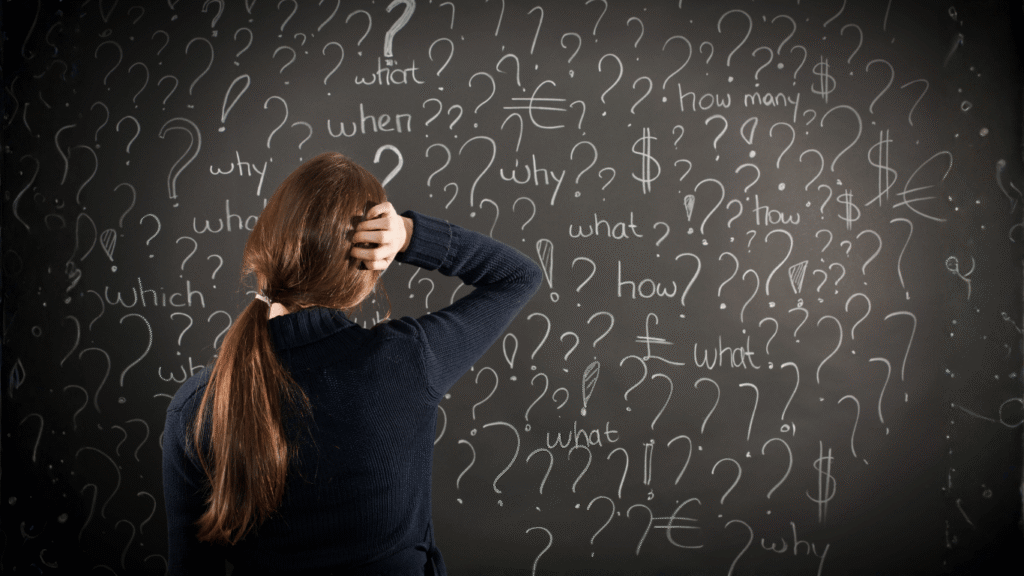
But I don’t know isn’t always empty. Sometimes it is crowded. And when everything is speaking at once, thinking harder may simply turn up the volume.
Not all thinking takes us somewhere
There are times when returning to a decision reveals something. Maybe I discover information I didn’t have before, realise I was making an assumption, or simply see the situation differently. That kind of thinking moves.
Then there is another kind that seems to go in circles. I revisit the same conversation, imagine the same possible outcomes, questions something I had already decided, or ask another person what they would do. For a moment their answer helps, then another thought arrives and the whole thing starts again.
The mind can be incredibly active while going nowhere.
This is what makes overthinking a decision difficult to recognise. From the inside, it can still feel productive because we are thinking so much. But activity and movement are not always the same thing. Like walking around the same block, there may be a lot of steps without actually getting anywhere new.
Maybe we are looking for certainty
If I already have enough information to understand the situation, why do I keep searching?
Sometimes I am not searching for more information at all. I am searching for certainty. I want to know that if I choose this, I won’t regret it. That the other person will respond well. The opportunity will work and I won’t discover six months from now that the other option would have been better.
In a way, I want the decision to come with a preview of the future.
But important decisions rarely offer that. There is usually something we cannot know until we move. The mind can keep thinking because it is trying to solve something thinking cannot completely solve: uncertainty itself.
That changes the question for me. Instead of asking What else do I need to think about?, I become more curious about what is making it difficult to stop thinking about it.
What different signals become one noise
This is where emotional clarity has become important in the way I understand decisions. Not because emotion gives us the answer, and not because logic does either. I see them more as different sources of information.
Suppose I am thinking about leaving something that no longer feels right. I might know logically that staying is the safer option, feel relieved when I imagined leaving, and still afraid of losing security. Someone I respect may believe leaving is a mistake. A previous experience may make me cautious. Underneath all of this, I may have been noticing small things for months that I haven’t really paid attention to.
Which one is the truth?
Perhaps they are all telling me something, just not the same thing.
Fear may be showing me that I could lose. Emotion may be showing me how the situation is affecting me. Evidence may tell me what is actually happening. Past experience may be trying to protect me. Someone else’s opinion may offer a perspective I hadn’t considered. And that quieter internal feeling may be worth exploring too.
The difficulty comes when I hear all of them as one voice. Fear can sound like intuition. And assumption can feel like a fact. Someone else’s expectation can slowly become something I think I should want. An emotion can become a conclusion before I understand what it is responding to.
Perhaps clarity begins by giving these different signals some space from each other.
There is what happened — and what we add to it
I find myself coming back to this distinction.
There is the situation itself, and then there is everything my mind has built around it.
Something happened. That is one layer. What I think it means is another. What I fear will happen next is another. What I believe someone else with think is another.
They become so tightly woven together that eventually I cannot see where the event ends and my interpretation begins.
Pulling at those threads doesn’t mean dismissing what I feel. It simply allows me to notice the difference between this I know, this I’m assuming, this I’m afraid of, this matters to me, this can from someone else and this…I’m still trying to understand.
I particularly like that last one.
We don’t always have to immediately name what we are experiencing. Sometimes something needs to remain a question for a while.

And then there is intuition
I am particularly curious about intuition because it can be easy to either romanticise it or dismiss it. Neither feels useful to me.
Sometimes we notice something before we can explain how we noticed it — a change in someone’s behaviour, a pattern that feels familiar, something about an opportunity that makes us hesitate, or a sense that something is not quite lining up.
That doesn’t automatically mean the feeling is correct. But I don’t think it means we should ignore it either.
I prefer to treat it as something to investigate. What am I actually noticing? What might I have picked up? Is there anything in the situation that supports this feeling? Could fear or an old experience also be influencing it?
I don’t need to immediately decide between this is intuition and this is anxiety. Sometimes curiosity gives me more information than either label.
Clarity may be quieter than certainty
I used to imagine clarity as something very definite, almost like reaching the end of a maze and suddenly seeing the whole path.
But I’m beginning to think clarity can be much quieter than that.
I can know what direction feels right and still be nervous. I can make a decision and still recognise what I am giving up. I can understand what matters to me without knowing whether everything will work out.
There can still be uncertainty around a clear decision.
Maybe clarity isn’t when every competing voice disappears. Maybe it is when I can finally hear them separately enough to recognise which one deserves my attention.
And perhaps that is why more thinking doesn’t always make a decision clearer.
Sometimes there is nothing more to add. There is something to separate, something to notice, something to question — and perhaps something we already know, quietly waiting underneath all the noise.
So when I find myself returning to the same direction, I’m learning to ask something slightly different:
Am I discovering something new — or am I hoping that thinking about this one more time will finally make me certain?
The answer doesn’t make the decision for me. But it tells me something about what I may actually looking for.
And sometimes, that is where clarity starts.
A space to hear yourself more clearly
Some things are difficult to see while we are standing in the middle of them. Thoughts, emotions, expectations, fears and quieter internal signals can become so intertwined that we no longer know which thread we are following.
That is part of why I created the Emotional Clarity Circle — a small, live online coaching space for slowing some of the internal noise down and exploring what is actually happening underneath it.
There is no pressure to arrive with an answer, and I am not there to make the decision for you.
Sometimes we simply need enough space to hear ourselves think.
Explore the Emotional Clarity Circle.